QHF / Personal correspondence

Personal style. Purposeful control.
Quantum Handwriting
Font Engine
Give typed words a personal handwriting style, with the author's permission built into the document workflow.
Character-level variation · PDF and HTML · Author-controlled access
The same message, a different personal touch
Handwriting you can explore.
Three synthetic demonstration profiles, generated using QHF's training and rendering pipeline. No real author's handwriting is published here.
Your words
Ink
Each letter is sampled from its saved probabilities. Style changes do not change the message.
Demo shapes are derived from Caveat, Patrick Hand and Kalam under their open font licenses, with synthetic variations. QHF learns a distribution over those variants; this is not evidence of handwriting realism or quantum advantage.
One coherent workflow
From a real sample to a readable document.
CaptureCharacter samples
EncodeGeometric features
TrainVariant probabilities
SampleRuntime selection
RenderDocument output
The portal, without an account screen
A focused experience.
A complete engine behind it.
The live portal separates everyday documents from author training and research. This offline tour shows the capabilities without connecting to an account or changing real permissions.
A character, captured by hand.
The authenticated author types a character label, draws genuine samples, and trains that character under their own identity. Two to ten variants avoid treating one fixed shape as an entire style.
- Mouse, pen and touch input
- Undo, clear and adjustable pen width
- Per-character samples and persistent models
- Existing models for other letters stay intact
This local pad captures and exports samples only. Model training runs in the authenticated portal.
0 samples
Many characters. One author.
Upload a prepared JSON file in the live training workspace. It validates the author and glyph samples before sequential training, then reports saved, failed and unprocessed characters separately.
- Single-author files up to 5 MB
- Two to ten SVG variants per character
- Ownership checks on the server
- Stop safely after the current character
This file check is local. It does not train, upload or save a model.
No file selected
{
  "characters": {
    "a": [
      {"variant_id": "a_1", "svg_data": "..."},
      {"variant_id": "a_2", "svg_data": "..."}
    ]
  }
}
Typed content, author-style output.
Type a message or upload readable PDF or HTML content. QHF selects variants from an existing trained profile and reflows them into a consistent document.
- Text entry or file upload, not both at once
- Consistent ink, character scale and baseline
- PDF and HTML preview and download
- Coverage reporting and readable fallback
The current converter uses A4 reflow. Source tables, images and exact page layout are not preserved, and DOCX conversion is not included.
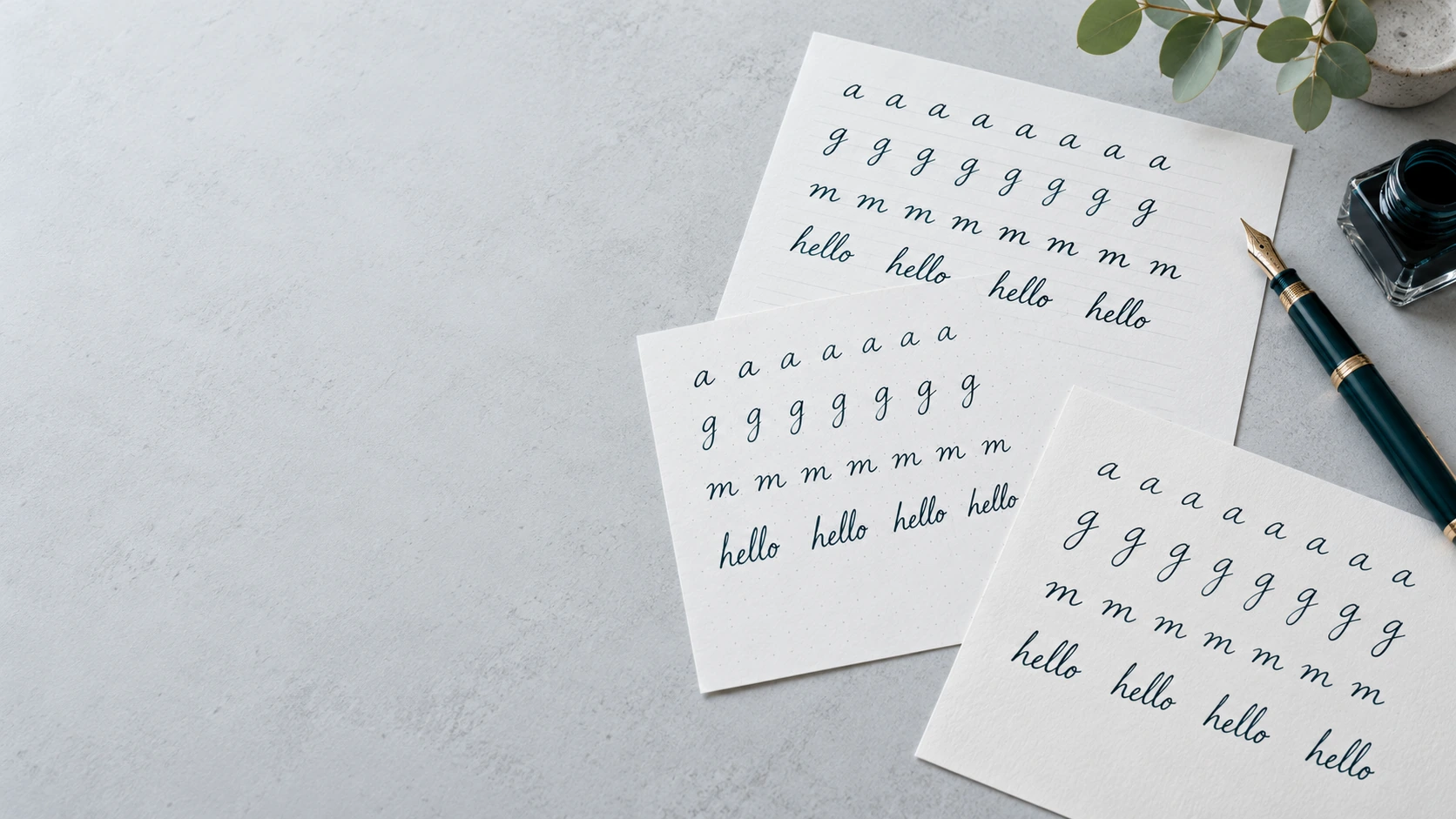
Prepared QHF outputs
The author decides how a style is used.
Your own profile can render directly. Another author's handwriting follows a purpose-specific request, review and grant before access.
- Authenticated author and requester
- Separate preview and download permissions
- Expiry, denial, withdrawal and audit events
- Encrypted source storage in the secure workflow
Downloaded copies and screenshots cannot be recalled. These controls protect future server access, not every copy of a document.
Reusable profiles, traceable outputs.
Each author has a separate character library, saved glyph variants and probability vectors. The full workspace adds text rendering, model export and a demonstration pipeline.
- Coverage before rendering
- Single-character updates and bulk profiles
- SVG text and document previews
- Exported font/model payloads for integrations
Weighted variant selection runs in QHF's renderer. Standard OpenType does not provide native arbitrary probability weights.
| Profile | Characters | Variants | Model |
|---|
Useful when personal style matters
Practical documents.
Responsible possibilities.
Document workflows exist today. Wider sector adoption needs consent, representative samples, operational pilots and independent validation.
Personal correspondence
Letters and family messages with a familiar handwriting style.
Education
Teacher feedback, practice material and personalized learning notes.
Assistive communication
Reuse a familiar style when writing becomes difficult. No clinical outcome is claimed.
Healthcare and public services
Appointment reminders and service correspondence, with an auditable purpose.
Enterprise and cultural archives
Controlled personalized communication and permission-based derivative material.
Evidence, not mystique
A quantum model you can inspect.
These measurements come from the synthetic examples built for this showcase. They are not a handwriting-realism benchmark or a demonstration of quantum advantage.
Measurement probabilities, not raw complex amplitudes, reach the renderer.
Target weights use geometric similarity to a feature centroid, not observed writing frequencies. A classical categorical sampler can reproduce the same weights.
Training-loss comparison
With CNOT Without CNOTObjective evaluations, same initialization seed and parameter count. The direct categorical target has KL loss 0 by construction; it is a reference, not a timed performance result.
| Experiment | Final KL | Evaluations | Actual circuit depth |
|---|
What is implemented, and what remains a limitation?
Implemented: exact classical statevector simulation, COBYLA optimization, a Grover-style amplification alternative, CNOT ablation, KL history, probability outputs and register-cut entanglement entropy.
Not established: superior visual realism, faster training than classical models, production or statutory certification, hardware-noise robustness, context-aware handwriting or a physical signature. Qubits index glyph variants, not separately validated pressure/slant variables.
Optimizer status: the current SPSA label aliases to COBYLA; it is not a separate operational SPSA implementation. Grover-style amplification is not another continuous KL optimizer.
API extensions: the backend also contains endpoints for TTF/animated rendering, comparison, blending and analysis. These integration endpoints are not all exposed as polished workflows in the current portal.